Pacific · Air War · Japan vs United States
Japan Launches Its Balloon Bombs
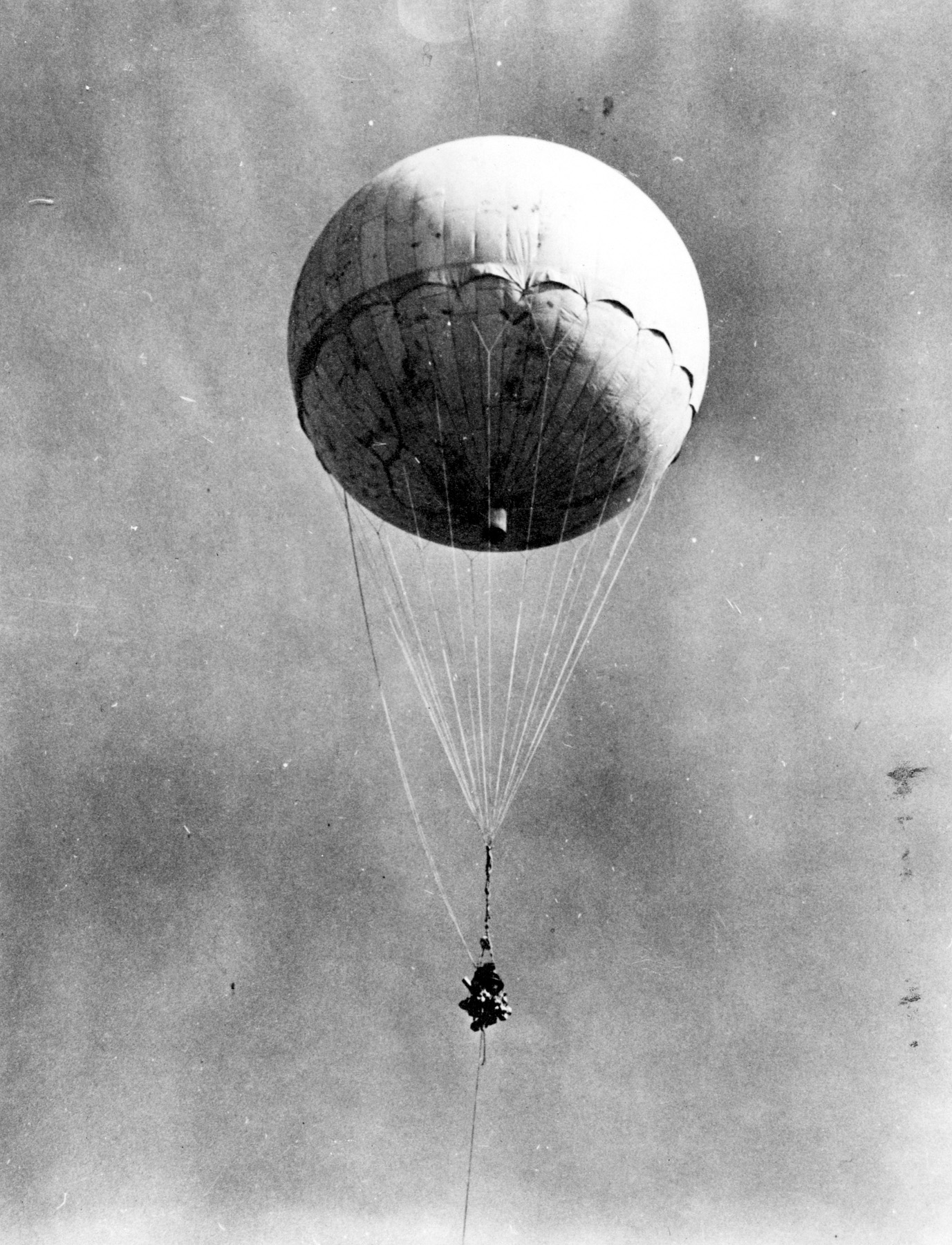
From the beaches of Honshu, Japan releases the first of some 9,300 paper balloons carrying bombs on the jet stream across the Pacific towards North America.
- Launch sites
- East coast of Honshu, Japan
- First launch
- 3 November 1944
- Balloons launched
- About 9,300, the last on 20 April 1945
- Found or observed
- About 300 in the United States, Canada and Mexico
- Deaths
- 6 civilians near Bly, Oregon, 5 May 1945
- War clock
- Day 1,891 of 2,194
Japan had no way of bombing the American mainland with aircraft. Its scientists found another route: the powerful winter jet stream that races eastward high above the Pacific. A balloon riding it could cross the ocean in about three days. The result was the Fu-Go weapon, and on 3 November 1944 the first balloons rose into the sky.
Each balloon was 10 metres across, made of paper and filled with hydrogen. Beneath it hung a ring of sandbags and a barometric device. When the balloon sank below about 9,100 metres, a sandbag was released and it climbed again; if it rose above about 12,000 metres, hydrogen was vented. Once the ballast was spent over America, the final stations dropped their incendiary bombs, and the balloon destroyed itself as it released one last bomb.
About 700 were launched in November 1944, rising to 2,500 in each of February and March 1945. In all some 9,300 were sent. Around 300 were found or seen in the United States, Canada and Mexico, from the Pacific coast to Montana, Wyoming and Kansas.
About 700 were launched in November 1944, rising to 2,500 in each of February and March 1945. In all some 9,300 were sent. Around 300 were found or seen, from Alaska and Canada to Mexico, and as far inland as Montana, Wyoming and Kansas.
Silence and tragedy
On 4 January 1945 the US Office of Censorship asked editors and broadcasters not to report the balloons, so that Japan would learn nothing of their arrival. Starved of evidence, and short of paper and hydrogen, the Japanese Army stopped the campaign in April. On 5 May 1945, near Bly in Oregon, Elsie Mitchell and five children on a church outing found a fallen balloon in the forest. It exploded, killing all six, the only deaths caused by enemy action on the American mainland during the war.
Sources and further reading
Lead image: A recovered Japanese balloon bomb reinflated by US investigators at Moffett Field, California. U.S. Army, Public domain, via Wikimedia Commons. See our sources and image policy.
 United Kingdom
 United States
 Soviet Union
 Germany
 Japan
 France
 Poland
 South Africa