Western Europe · Air War · United Kingdom vs Germany
The Bombing of Lübeck
On Palm Sunday night, RAF Bomber Command sets fire to the medieval heart of Lübeck, the first great success of its new campaign against German cities.
- Date
- Night of 28 to 29 March 1942
- Force
- 234 Wellingtons and Stirlings
- Bombs
- About 400 tons, including some 25,000 incendiaries
- Killed
- About 300 to 320
- RAF losses
- 12 aircraft
- War clock
- Day 940 of 2,194
Weeks after Arthur Harris took over Bomber Command, he chose Lübeck, an old Hanseatic port on the Baltic, as a target. It was not a vital military objective. But its old town of timbered medieval buildings was, in Harris’s words, built more like a fire-lighter than a human habitation, and it would test whether a first wave of bombers could start fires to guide those that followed.
Palm Sunday
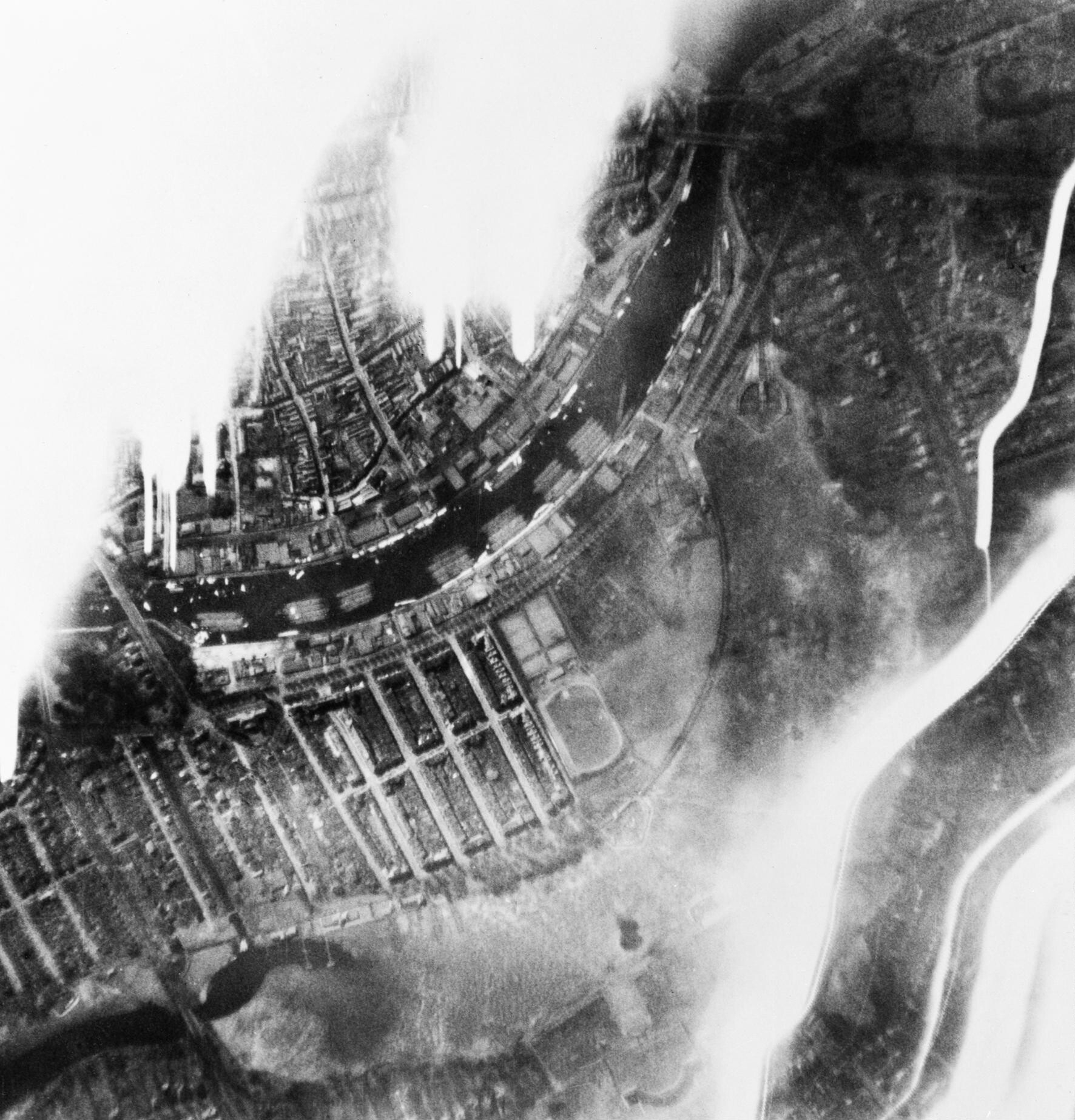
On the night of 28 to 29 March 1942, 234 Wellington and Stirling bombers dropped about 400 tons of bombs, including some 25,000 incendiaries. Fires swept a corridor through the old town from the cathedral to St Peter’s Church, the town hall and St Mary’s Church. German police counted 301 dead and 783 injured, more than 15,000 people lost their homes, and the RAF lost 12 aircraft.
Sources and further reading
Lead image: An RAF aerial photograph of Lübeck taken during a Bomber Command raid. RAF official photographer, Public domain, via Wikimedia Commons. See our sources and image policy.
 United Kingdom
 United States
 Soviet Union
 Germany
 Japan
 France
 Poland
 South Africa