Eastern Front · Land Battles · Germany vs Soviet Union
Case Blue
Germany launches its great summer offensive in southern Russia. The goal is the oil of the Caucasus; the road will lead to Stalingrad.
- Operation
- Fall Blau (Case Blue)
- Initial objective
- Voronezh and the Don river
- Main goal
- Caucasus oil fields
- Fatal change
- Directive 45 split the offensive, 23 July 1942
- War clock
- Day 1,032 of 2,194
After failing to take Moscow in 1941, Hitler decided that the 1942 campaign would focus on the south. Germany needed oil, and the fields of the Caucasus, around Maikop, Grozny and Baku, were its prize. The plan also aimed to reach the Volga at Stalingrad to protect the flank.
The attack
On 28 June 1942 Army Group South attacked towards Voronezh. Other armies joined over the following days. Soviet forces, weakened by the disaster at Kharkov, fell back. The Germans advanced rapidly across the open steppe, though they captured fewer prisoners than they hoped, as Soviet armies retreated rather than being encircled.
The split
Encouraged by early success, Hitler issued Directive 45 on 23 July, ordering Army Group A to take the Caucasus and Army Group B to take Stalingrad at the same time. The German forces were stretched across enormous distances, their flanks held by Romanian, Italian and Hungarian armies.
Sources and further reading
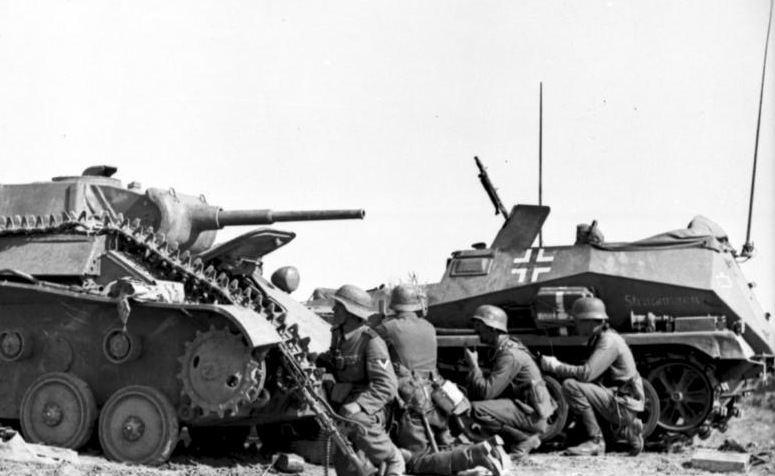
Lead image: German troops on the southern Eastern Front, summer 1942. Klintzsch, CC BY-SA 3.0 de (licence), via Wikimedia Commons. See our sources and image policy.
 United Kingdom
 United States
 Soviet Union
 Germany
 Japan
 France
 Poland
 South Africa