North Africa · Land Battles · South Africa and Britain vs Germany and Italy
The Fall of Tobruk
After a single day’s assault, the fortress that held out for eight months in 1941 surrenders to Rommel. Its South African commander and tens of thousands of men become prisoners.
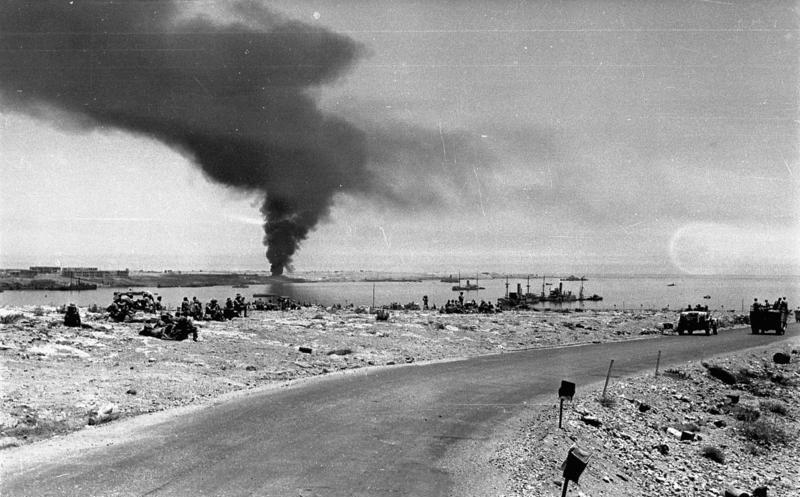
- Location
- Tobruk, Libya
- Garrison commander
- Maj Gen Hendrik Klopper, 2nd South African Division
- Prisoners
- Around 33,000, including over 10,000 South Africans
- Rommel
- Promoted to field marshal
- War clock
- Day 1,025 of 2,194
In late May 1942 Rommel attacked the British Eighth Army’s Gazala Line west of Tobruk. After weeks of hard fighting, in which South African, British, Indian, Free French and other troops took part, the Eighth Army was defeated and fell back towards Egypt. Tobruk was left with a garrison built around the 2nd South African Division.
The assault
Tobruk’s defences had been neglected since the siege of 1941, and the minefields had been partly lifted. On the morning of 20 June German dive bombers and artillery struck the south-eastern perimeter, and German and Italian armour broke through. By evening they had reached the harbour.
Surrender
With his communications broken and his position hopeless, Major General Hendrik Klopper surrendered on the morning of 21 June. Around 33,000 men went into captivity, and huge stores of fuel, food and vehicles fell to the Axis. Churchill, at the White House with Roosevelt when the news arrived, later called it one of the heaviest blows of the war.
Sources and further reading
Lead image: German troops at Tobruk, June 1942. Dörner, CC BY-SA 3.0 de (licence), via Wikimedia Commons. See our sources and image policy.
 United Kingdom
 United States
 Soviet Union
 Germany
 Japan
 France
 Poland
 South Africa