Western Europe · Air War · United States and Britain vs Germany
Big Week
With a break in the winter weather, the Allied air forces launch a week of massed attacks on the German aircraft industry. The real target is the Luftwaffe itself.
- Operation
- Argument, known as Big Week
- Dates
- 20 to 25 February 1944
- Forces
- US Eighth and Fifteenth Air Forces; RAF Bomber Command by night
- Targets
- Aircraft factories and assembly plants
- War clock
- Day 1,634 of 2,194
By early 1944 the planned Allied invasion of France depended on winning control of the air over Europe. The US Eighth Air Force had suffered heavy losses in unescorted daylight raids in 1943. Now long-range fighters, above all the P-51 Mustang, could escort the bombers deep into Germany. Planners waited for clear weather to launch a concentrated campaign against German aircraft production.
Six days
The weather finally cleared on 20 February 1944. Over the next six days, American heavy bombers from Britain and Italy attacked factories at Leipzig, Brunswick, Regensburg, Augsburg, Schweinfurt and other cities, while RAF Bomber Command attacked by night. The Luftwaffe rose to defend them in strength, and great air battles were fought.
Attrition
Losses were heavy on both sides. The damage to the factories was less than hoped, and German production soon recovered through dispersal. But the Luftwaffe lost many fighters and, crucially, many experienced pilots it could not replace.
Also on 20 February
- 1942US Navy pilot Edward “Butch” O’Hare shoots down several Japanese bombers attacking the carrier Lexington, earning the Medal of Honor.
Sources and further reading
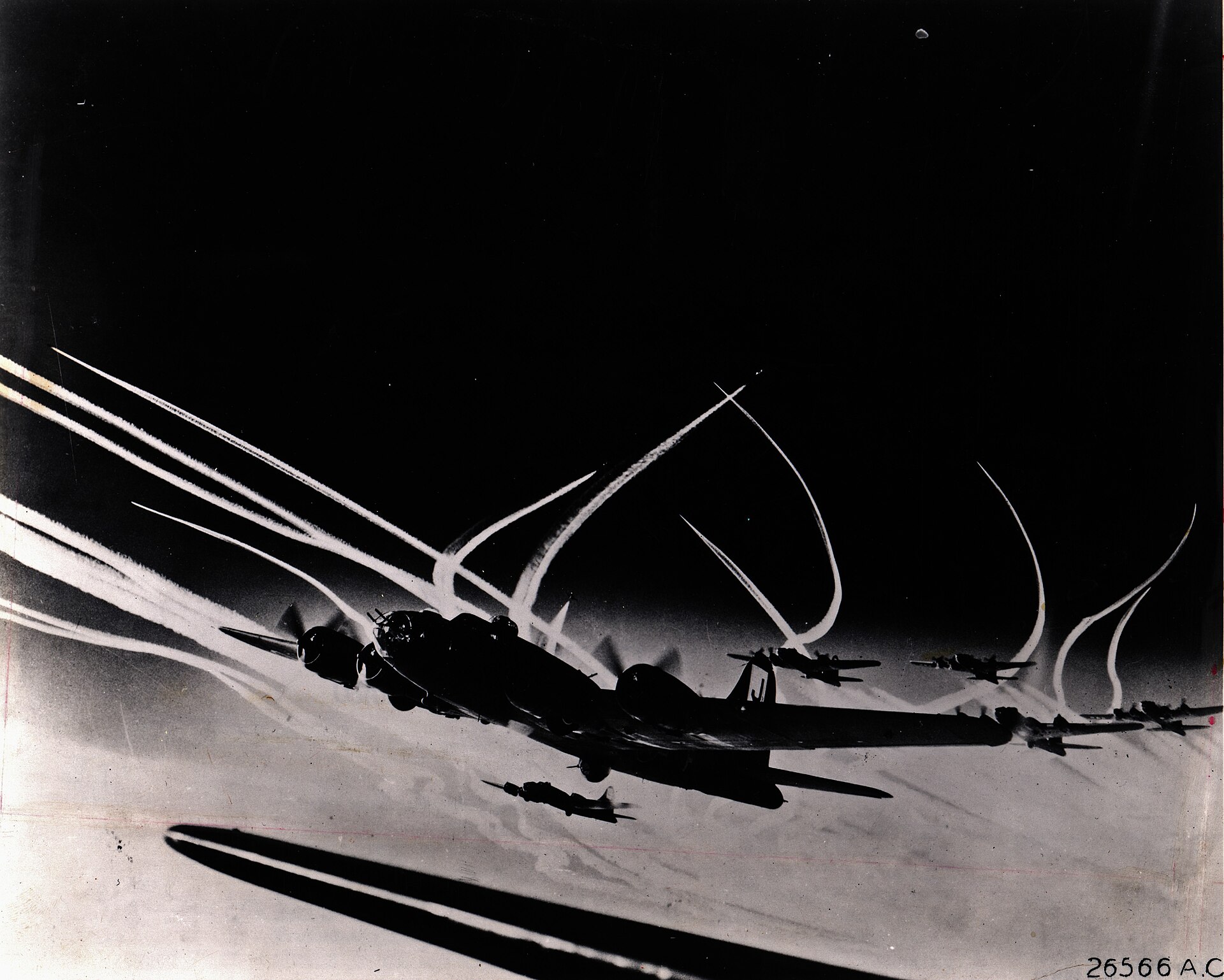
Lead image: A formation of Boeing B-17 Flying Fortresses trailing contrails. Sgt. Stanley M. Smith/United States Army Air Force, Public domain, via Wikimedia Commons. See our sources and image policy.
 United Kingdom
 United States
 Soviet Union
 Germany
 Japan
 France
 Poland
 South Africa