Pacific · Air War · United States and Australia vs Japan
The Battle of the Bismarck Sea
Allied bombers find a Japanese convoy carrying an army division to New Guinea. In three days of air attacks, every transport is sunk.
- Location
- Bismarck Sea, between New Britain and New Guinea
- Dates
- 2 to 4 March 1943
- Allied air forces
- US Fifth Air Force and Royal Australian Air Force
- Japanese losses
- All 8 transports and 4 of 8 destroyers
- War clock
- Day 1,279 of 2,194
In early 1943 the Japanese were determined to hold Lae on the north coast of New Guinea. A convoy of eight transports escorted by eight destroyers left Rabaul carrying troops of the 51st Division and supplies. Allied codebreakers and reconnaissance aircraft tracked it.
New tactics
General George Kenney’s Fifth Air Force had been training its crews in low-level attacks. B-25 Mitchells were fitted with extra forward-firing machine guns, and crews practised skip bombing, releasing bombs at mast height so they bounced across the water into the side of a ship. Australian Beaufighters were to strafe the ships’ decks and guns.
The attack
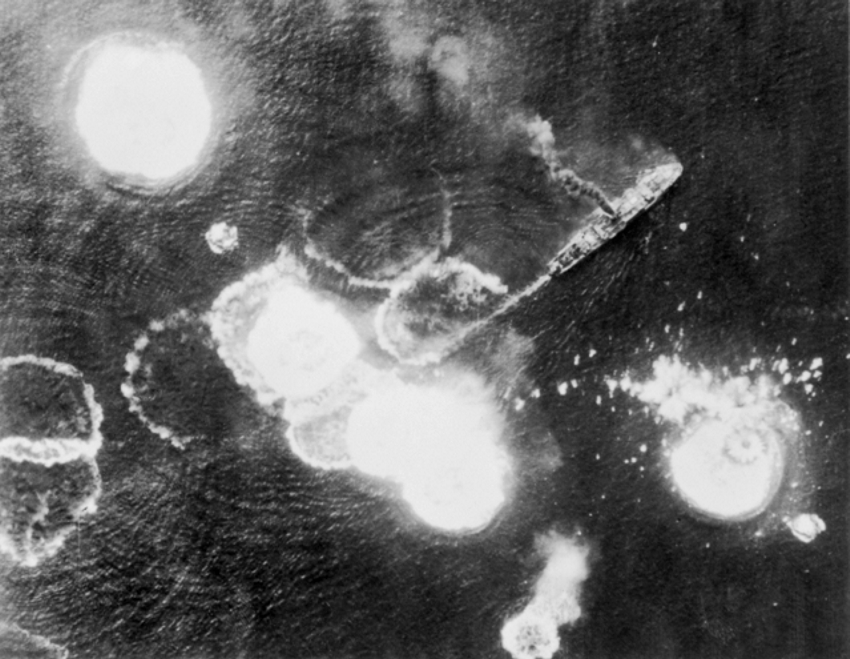
B-17s attacked the convoy on 2 March. On 3 March, in clear weather, the low-level attackers struck together with high-level bombers. Within minutes the transports were burning and sinking. Over the following days the remaining ships were finished off, and some aircrews strafed survivors in the water. Around 3,000 Japanese soldiers and sailors were lost.
Sources and further reading
Lead image: A Japanese transport under air attack in the Bismarck Sea. Australian armed forces, Public domain, via Wikimedia Commons. See our sources and image policy.
 United Kingdom
 United States
 Soviet Union
 Germany
 Japan
 France
 Poland
 South Africa