Eastern Front · Land Battles · Germany vs Soviet Union
The Fall of Kiev
German troops enter Kiev. East of the city, four Soviet armies are trapped in a vast encirclement. It is the largest single encirclement of the war.
- German pincers
- Guderian’s Panzer Group 2 and Kleist’s Panzer Group 1
- Soviet front
- Southwestern Front under Colonel General Mikhail Kirponos
- Pocket eliminated
- 26 September 1941
- Prisoners
- Hundreds of thousands
- War clock
- Day 750 of 2,194
In August 1941 Hitler overruled his generals, who wanted to advance on Moscow, and sent Guderian’s panzer group south to trap the Soviet armies defending Kiev and the Dnieper line. Stalin refused to allow a withdrawal until it was too late.
The trap
Guderian’s panzers drove south from the Moscow front, and Kleist’s panzers north from the Dnieper bridgeheads. They met on 15 and 16 September near Lokhvitsa, east of Kiev. German troops entered the city on 19 September.
The cost
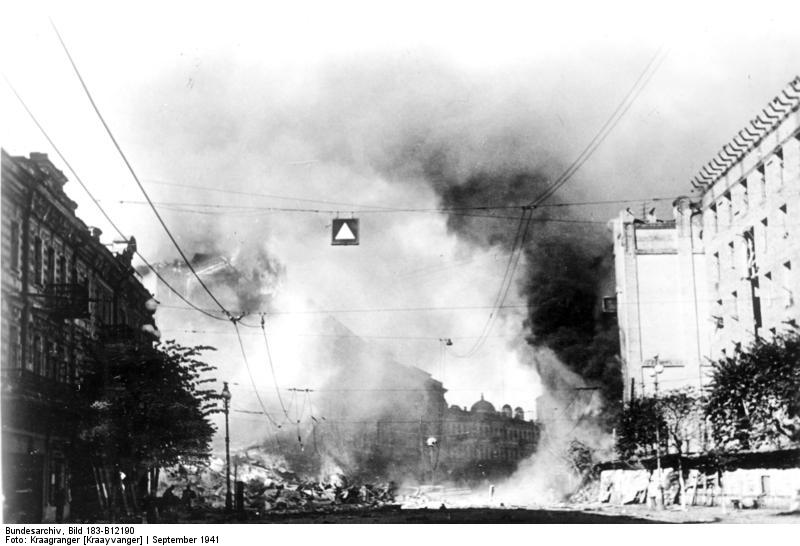
The Southwestern Front was destroyed. Its commander, Kirponos, was killed trying to break out. The pocket was eliminated by 26 September. Days after the Germans occupied Kiev, mines left by Soviet forces destroyed buildings on the main street, the Khreshchatyk. The Germans used this as a pretext for the massacre at Babi Yar.
Sources and further reading
Lead image: Fire on the main street of Kiev, September 1941. Kraagranger [Kraayvanger], CC BY-SA 3.0 de (licence), via Wikimedia Commons. See our sources and image policy.
 United Kingdom
 United States
 Soviet Union
 Germany
 Japan
 France
 Poland
 South Africa