Grand Strategy · Diplomacy · The Allies
The Potsdam Conference
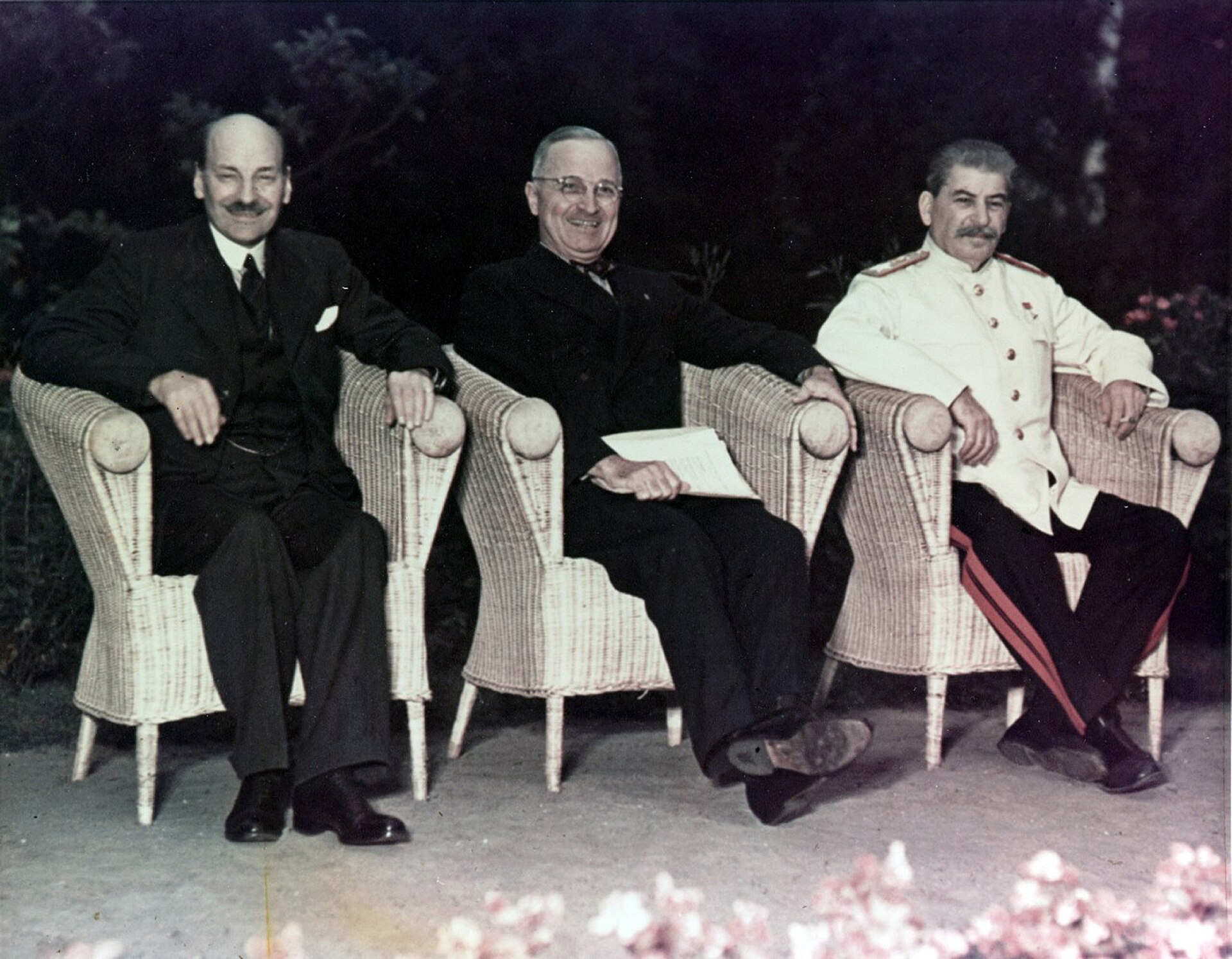
In a palace outside ruined Berlin, Truman, Stalin and Churchill meet to settle the fate of Germany. Halfway through, Churchill is replaced by Attlee.
- Location
- Cecilienhof Palace, Potsdam
- Dates
- 17 July to 2 August 1945
- Leaders
- Truman, Stalin, Churchill then Attlee
- Germany’s eastern border
- Oder-Neisse line, pending a peace settlement
- War clock
- Day 2,147 of 2,194
Germany had surrendered, but much remained to be decided: how to govern the occupied country, what reparations to take, Poland’s borders, and the war against Japan. The three Allied leaders met at Potsdam, near Berlin. Truman was attending his first conference; Roosevelt had died in April.
Decisions
The leaders agreed that Germany would be governed through an Allied Control Council, with policies of demilitarisation, denazification, democratisation and decentralisation. Reparations would mostly be taken from each power’s own zone. Poland was given German territory east of the Oder and Neisse rivers, and the transfer of German populations was approved.
Changes at the table
On 24 July Truman told Stalin that the United States had a new weapon of unusual destructive force. Stalin, informed by his spies, showed little reaction. Midway through the conference, the British election results were announced, and Clement Attlee replaced Churchill as prime minister.
Sources and further reading
Lead image: Attlee, Truman and Stalin at the Potsdam Conference. US Army Signal Corps, Public domain, via Wikimedia Commons. See our sources and image policy.
 United Kingdom
 United States
 Soviet Union
 Germany
 Japan
 France
 Poland
 South Africa