Grand Strategy · Diplomacy · United States and United Kingdom
The Casablanca Conference
Roosevelt and Churchill meet in liberated Morocco to plan the next year of the war. They leave with a decision on Sicily and a demand the Axis will hear loud and clear: unconditional surrender.
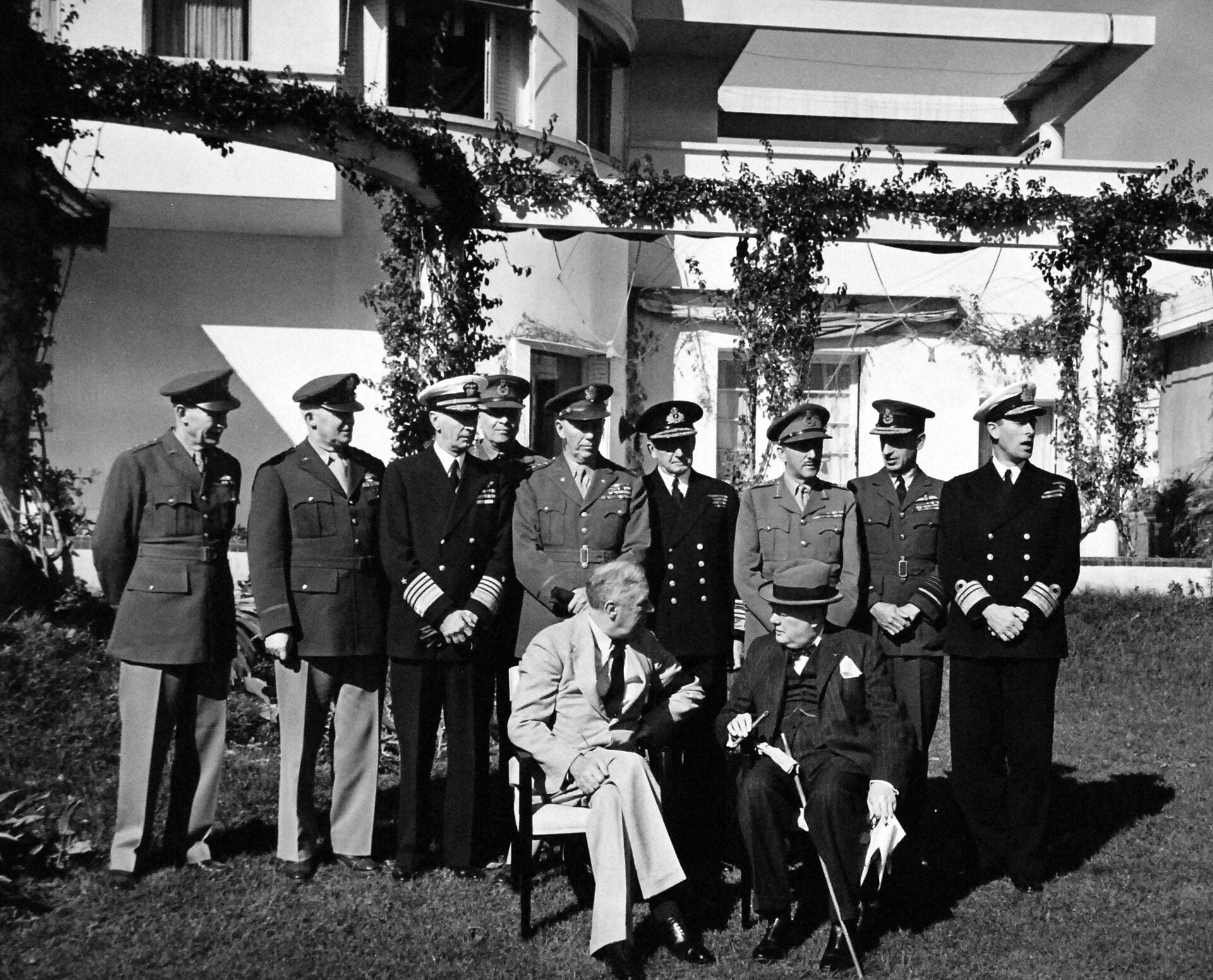
- Location
- Anfa Hotel, Casablanca, Morocco
- Dates
- 14 to 24 January 1943
- Leaders
- Franklin D. Roosevelt and Winston Churchill
- Absent
- Joseph Stalin, who declined to attend
- War clock
- Day 1,232 of 2,194
The Allied landings in French North Africa in November 1942 had brought Morocco and Algeria into the Allied camp. With the campaign in Tunisia still under way, Roosevelt and Churchill needed to agree on what came next. Stalin was invited but stayed in Moscow while the Battle of Stalingrad reached its climax.
The debate
The American chiefs of staff wanted to concentrate on an invasion of France across the Channel as soon as possible. The British argued that the Allies were not yet ready and that forces already in the Mediterranean should be used to knock Italy out of the war. The British view won for 1943: once Tunisia was cleared, the next step would be Sicily. The leaders also agreed to step up the combined bomber offensive against Germany and give priority to defeating the U-boats.
Unconditional surrender
The two leaders also brought together the rival Free French leaders Charles de Gaulle and Henri Giraud. At a press conference on 24 January, Roosevelt announced that the Allies would accept nothing short of the unconditional surrender of Germany, Italy and Japan.
Sources and further reading
Lead image: Roosevelt and Churchill at the Casablanca Conference, January 1943. National Museum of the U.S. Navy, Public domain, via Wikimedia Commons. See our sources and image policy.
 United Kingdom
 United States
 Soviet Union
 Germany
 Japan
 France
 Poland
 South Africa