Western Europe · Air War · Germany vs Britain
The First V-1
A week after D-Day, a pilotless jet-propelled bomb falls on a railway bridge in east London. Germany’s vengeance weapon campaign has begun.
- Weapon
- Fieseler Fi 103, the V-1 flying bomb
- First to hit London
- Grove Road, Bow, east London
- Nicknames
- Doodlebug and buzz bomb
- British deaths from V-1s
- Around 6,000
- War clock
- Day 1,748 of 2,194
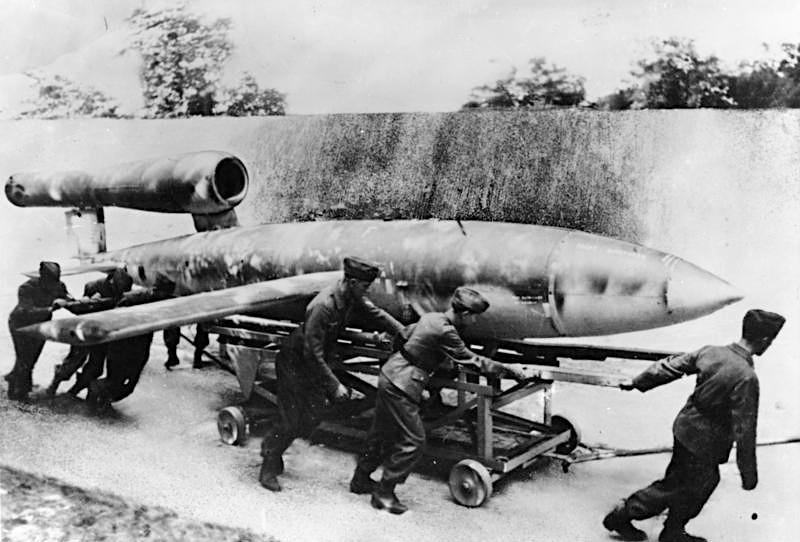
Since 1943 Allied intelligence had known Germany was developing long-range weapons. The V-1, short for Vergeltungswaffe or vengeance weapon, was a small pilotless aircraft with a pulse-jet engine and a warhead of around 850 kilograms. It was launched from ramps in northern France, aimed at London, and dived when its fuel was cut off.
Grove Road
In the early hours of 13 June 1944 the first V-1s were launched. One fell on a railway bridge at Grove Road in Bow, east London, killing six people. Within days, dozens a day were being fired. Londoners learned to listen for the drone of the engine: when it stopped, the bomb was about to fall.
The defence
Anti-aircraft guns were moved to the coast, where new proximity fuses made them far more effective. Fast fighters chased the bombs, shooting them down or tipping them over with a wingtip. Barrage balloons caught others. By September the launch sites in France had been overrun.
Also on 13 June
- 1944A single Tiger tank commander, Michael Wittmann, ambushes a British column at Villers-Bocage in Normandy.
Sources and further reading
Lead image: A V-1 flying bomb. Lysiak, CC BY-SA 3.0 de (licence), via Wikimedia Commons. See our sources and image policy.
 United Kingdom
 United States
 Soviet Union
 Germany
 Japan
 France
 Poland
 South Africa