Grand Strategy · Diplomacy · Soviet Union and Japan
The Soviet-Japanese Neutrality Pact
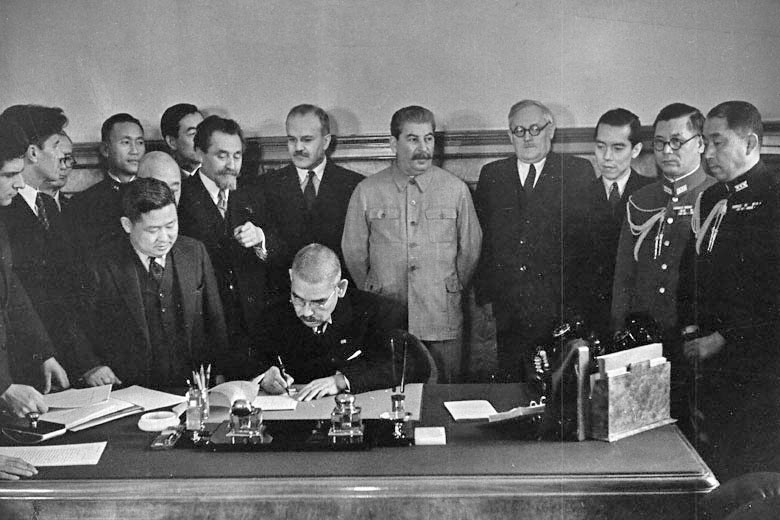
In the Kremlin, Japan’s foreign minister and Molotov sign a five-year neutrality pact. Stalin himself turns up at the railway station to see the Japanese delegation off.
- Signed
- 13 April 1941, Moscow
- Signatories
- Yosuke Matsuoka and Vyacheslav Molotov
- Duration
- Five years
- Ended
- Soviet declaration of war, 8 August 1945
- War clock
- Day 591 of 2,194
Japan and the Soviet Union had fought a short, bitter border war at Khalkhin Gol in 1939, which the Soviets won decisively. By 1941 both wanted security on their shared frontier. Japan was looking south, towards the colonies of Southeast Asia; Stalin feared a war on two fronts.
The pact
Foreign Minister Yosuke Matsuoka, returning from talks in Berlin and Rome, stopped in Moscow. On 13 April 1941 he and Molotov signed a pact in which each country promised to remain neutral if the other was attacked by a third power. Stalin was so pleased that he appeared at the station to see Matsuoka off, a rare public gesture.
Consequences
When Germany invaded the Soviet Union in June, Japan stayed out, despite German hopes. By the autumn, with intelligence suggesting Japan would strike south, Stalin was able to move divisions from Siberia to the defence of Moscow. Japan turned towards war with the United States and Britain.
Also on 13 April
- 1943Germany announces the discovery of mass graves of Polish officers in the Katyn forest.
- 1945The Red Army completes the capture of Vienna.
Sources and further reading
Lead image: Yosuke Matsuoka signs the Soviet-Japanese Neutrality Pact in Moscow. Николай Сидорович Власик (1896-1967), Public domain, via Wikimedia Commons. See our sources and image policy.
 United Kingdom
 United States
 Soviet Union
 Germany
 Japan
 France
 Poland
 South Africa